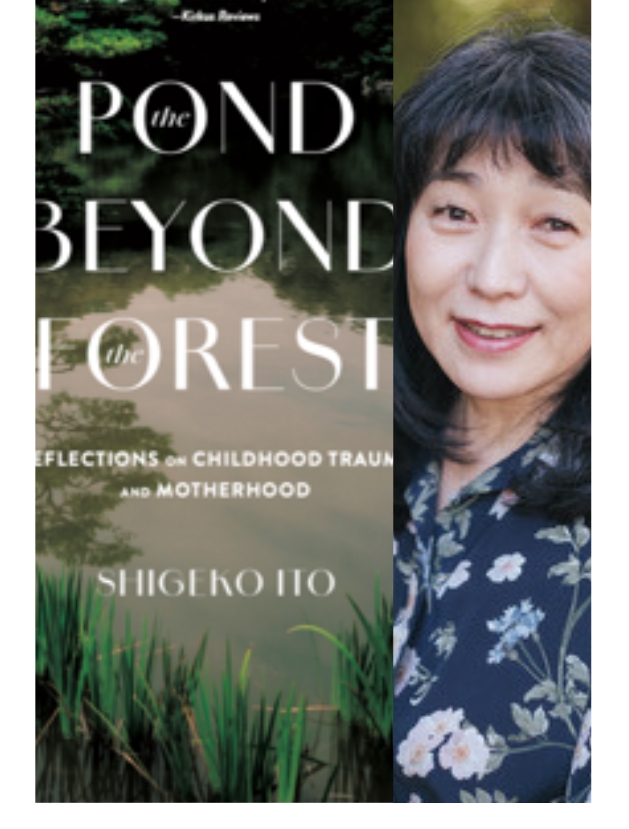


You know that thing when you thought you’d outrun your childhood by just doing everything right and dodging the missteps of ancestors, but then one day you’re perimenopausal with a family of your own and your childhood trauma is like, Mwahahaha, there you are my pretty, I’ve got you now? Well, if you do, would you like to read a book that talks about it honestly and is also laugh-out loud funny? If so, I will now press into your hands you a copy of Shigeko Ito’s new memoir, The Pond Beyond the Forest. I love the candor of Shigeko’s writing and her ability to show the humor in the moments when the chaos of life and the drumbeat of trauma collide. And, Shigeko is here to talk with us about the writing of her memoir coming out this week, The Pond Beyond the Forest: Reflections on Childhood Trauma and Motherhood (She Writes Press, October 7, 2025).
Theo Nestor: Welcome, Shigeko! Please tell readers a bit about your memoir, The Pond Beyond the Forest.
Shigeko Ito: The Pond Beyond the Forest explores the lasting legacy of childhood emotional neglect and intergenerational trauma. The nonlinear narrative alternates between my present life as a mother and wife raising a teenage son in Seattle and my troubled upbringing in Japan. Raw, honest, and poignant, this memoir breaks the silence on invisible trauma, illuminating how it ripples across motherhood, marriage, and mental health—a profound journey that ultimately leads to healing and reclaiming the authentic self.
Theo Nestor: What was the biggest challenge in writing these essays and forming this collection and how did you overcome it?
Shigeko Ito: I faced several challenges, and it’s hard to single out just one as the biggest. The entire process spanned nearly a decade, and sustaining my motivation was often a real struggle. I also wrestled with defining the central theme and identifying the structure that best suited my story. Gaining clarity on the structure was a huge relief, though articulating the theme took much longer.
I’ve always been more of a pantser than a plotter. Early on, while taking your Yearlong Memoir Manuscript class at Hugo House, you encouraged us students to create an outline, but I couldn’t because my process was largely exploratory, organic, and sometimes chaotic. In hindsight, an outline might have helped me finish more quickly, but working without one gave me the time and freedom to continue honing my craft through classes, retreats, and residency programs. Similarly, not having a hard deadline was both a blessing and a risk—it allowed me to mature as a writer and as a person at my own pace, but it also carried the very real danger of never actually finishing.
What carried me through was trusting the process and holding fast to the belief that I had an important message to share. That sense of calling, combined with persistence and perseverance, ultimately brought the project to the finish line. I see this work as my legacy project with a long tail, as well as a launch pad I can leverage to raise awareness about the lasting and often overlooked effects of invisible childhood trauma.
Theo Nestor: What was something that surprised or delighted you in the process of writing these essays?
Shigeko Ito: I discovered that the true power of writing a memoir lies in the process, not just the end product. Revisiting and engaging with painful memories gave me a second chance to process them with greater objectivity, clarity, and maturity. I developed the perspective of an observer with curiosity, which helped to establish a more constructive relationship with my past. By piecing together fragmented memories, I uncovered the root causes of my lifelong struggles. This awareness led me to cultivate greater self-kindness, compassion, and acceptance, which in turn helped tame my once-vicious inner critic. This journey felt deeply healing and empowering, much like self-generated psychotherapy.
Theo Nestor: What advice would you give to those working on a memoirwith the hope of publishing?
Shigeko Ito: If you’re under a tight deadline and need to finish a manuscript quickly, I may not be the best person to offer practical advice. But if you’re not pressed for time, I encourage you to embrace memoir writing as a profound journey of self-exploration. It’s a unique way to discover parts of yourself you didn’t even know existed. The writing can become an invaluable ally on this journey, guiding you toward deeper self-understanding and growth. If you feel a calling to share an important message, trust that instinct and don’t give up. The real magic happens during revision, so don’t be discouraged if your early drafts feel rough—they’re simply the foundation to build on, improving steadily until your manuscript truly feels ready.
Theo Nestor: Thanks so much, Shigeko! Where can readers connect with you online?
Shigeko Ito: Readers can find me here:
Website: shigekoito.com
Bluesky: bsky.app/profile/shigekoito.bsky.social
Facebook: facebook.com/shigekoitomemoir
LinkedIn: linkedin.com/in/shigekoito-memoir
Instagram: instagram.com/shigekochakoito
X (formerly Twitter): x.com/ShigekoChakoIto
Shigeko Ito grew up in Japan and immigrated to the United States to pursue higher education. She studied early childhood education, earning a PhD in Education from Stanford University. Drawing on cross-cultural experiences and academic expertise, she explores themes of trauma, resilience, and healing, with a particular focus on childhood emotional neglect. Her work has appeared on the CPTSD Foundation blog and the Anxiety and Depression Association of America website. In 2025, she was named a semifinalist in the nonfiction category of the Tucson Festival of Books Literary Awards. She worked in Montessori preschools for many years and lives in Seattle with her husband of thirty years and beloved animals. Author Website: shigekoito.com

 Writing Is My Drink
Leave a Reply