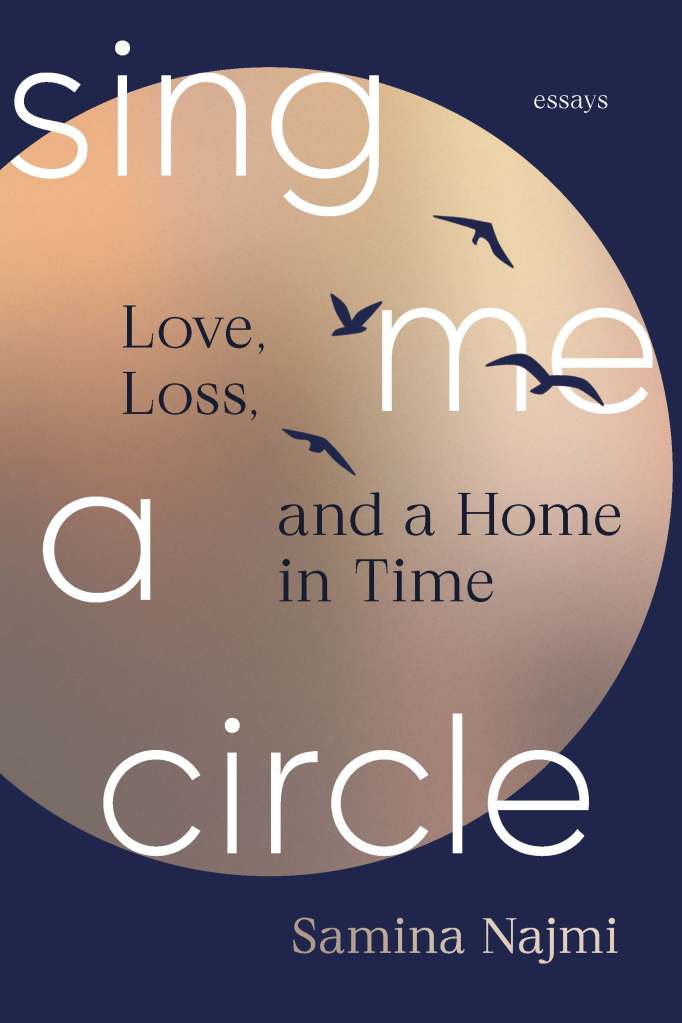
My favorite literary genre is the essay. And, my favorite essays are often those that begin in single moment and then whisk us up for a ride through time and space. Samina Najmi’s Sing Me a Circle is chock full of magic rides through the space-time continuum so artfully crafted that you might not even realize that you’ve been transported between a contemporary online thread about fan belts, 1970s Karachi, a London hospital twelve years earlier, and then to a Karachi classroom where a sparrow makes its final flight.
“All points on a circle are always the same distance from the center,” Najmi observes. The center in the essays in Sing Me a Circle is love and connection. Wherever she takes us–Boston, Fresno, Palestine, Karachi–she shows us how love and connection remain the constant, how this center can indeed hold.
Sing Me a Circle: Love, Loss and a Home in Time (Trio House Press)–winner of the 2024 Aurora Polaris Prize in Creative Nonfiction–will be in bookstores everywhere on October 1st. I’m so thrilled to have Samina Najmi here today with us to talk about the process of making of this beautiful essay collection.
Theo Nestor: Welcome, Samina! Please tell us a little bit about Sing Me a Circle.
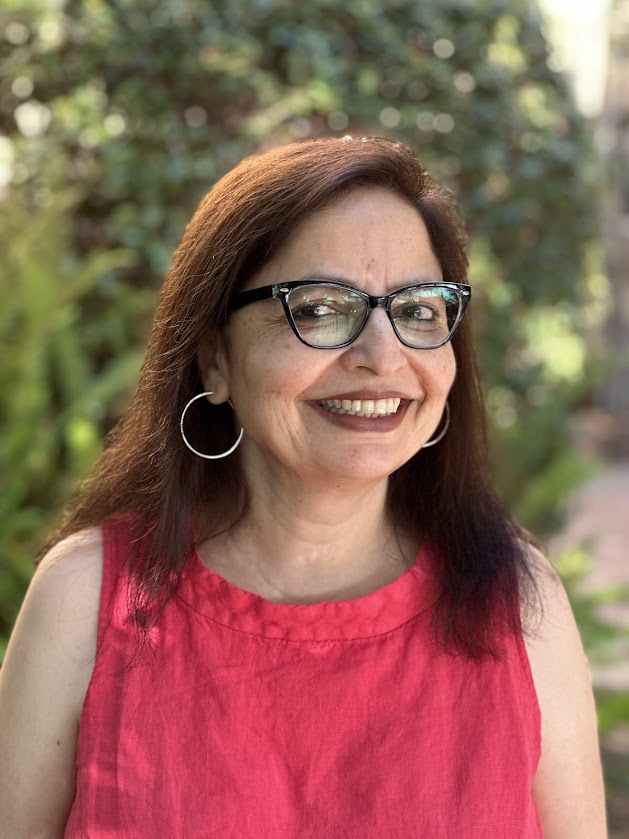
Samina Najmi: I wrote the essays in this book over the course of ten years. The first of these marked the tenth anniversary of 9/11, and I didn’t even know what genre of nonfiction to call it. But then I began taking workshops in creative writing and found myself steeped in recollections of growing up in Karachi, Pakistan. Those memoir essays eventually merged with others I had been writing about my present life as a mother and professor in Fresno, California. So while the book’s focus is on life lived day to day, it’s set in a broad sweep of space and time.
Theo Nestor: What was the biggest challenge in writing these essays and forming this collection and how did you overcome it?
Samina Najmi: In the beginning, I had to move away from seeing myself merely as an observer or documenter of events. I had to get comfortable with allowing my consciousness a more conspicuous role in the essays, shaping the reader’s interpretation of events. That often meant allowing an image to tell the story. Once I grasped that aspect of the craft, the individual essays sprouted pretty easily, and most also got published. Still, it took the collection three years to find a home. Looking back, I could have been more meticulous about submitting the manuscript to multiple presses at a time. But I liked doing my research on the publisher before sending the manuscript out, and that always took time.
Theo Nestor: What was something that surprised or delighted you in the process of writing these essays?
Samina Najmi: Many things. First, I was surprised how exhausting this work was—the excavation of one’s own thoughts and relationships and lived experiences. An early essay, “Abdul,” wiped me out. (It won Map Literary’s nonfiction prize that year, and that was an early indication to me of the demands and rewards of writing personal essays.) Then, I was surprised how satisfying it was just to articulate my thoughts on the page. There’s so much power in naming our experiences and making them coherent to ourselves. Beyond that, I was delighted to discover motifs and patterns, as though my life were a novel I was reading! That’s when I realized that life is generous in handing us metaphors; we just have to be able to read them. A most unexpected joy has been the feeling, especially when writing about grief or loss, that my burden is lightened when it’s shared with the reader.
Theo Nestor: What advice would you give to those working on an essay collection with the hope of publishing?
Samina Najmi: My own experience suggests that an essay collection will complete itself in its own time. It’s so dependent on one’s evolving consciousness that I don’t think it can be rushed. I wouldn’t be worrying too much about the shape of the collection until you have enough essays that you’re happy with, individually. Send those out. Eventually, you’ll take a step back and read your essays as a reader rather than as a writer: What do you see? What themes and patterns and images emerge? The essays don’t have to be interlinked, of course, and you might not be aiming for a memoir-in-essays. But you’ll see what they’re saying holistically. You’ll know when it’s time to declare the collection complete. Then send the manuscript out in small batches to presses you’ve researched. And do a better job than I did of compressing the intervals when you have no active submissions!
Theo Nestor: Where can readers connect with you online?
Samina Najmi: I’m easy to find on Instagram.
Theo Nestor: Thank you, Samina! I’m so looking forward to your book’s publication day.
Samina Najmi is Professor of English at California State University, Fresno. A scholar of race, gender, and war, she began writing memoir and personal essays in 2011. Her creative nonfiction has appeared in over thirty literary journals, including World Literature Today. Samina’s memoir- in-essays, Sing Me a Circle: Love, Loss, and a Home in Time, won the 2024 Aurora Polaris Award in creative nonfiction and will be published by Trio House Press on Oct 1, 2025. Publishers Weekly gives the book a starred review, and Poets & Writers features it among its top five creative nonfiction debuts of the year. Daughter of multigenerational displacements, Samina has lived in California’s Central Valley since 2006 and watched with wonder her children, her students, and her citrus grow. Come visit her at saminanajmi.com.

 Writing Is My Drink
Leave a Reply