
One of my great thrills as a reader is a piece of writing that perfectly inhabits an original form that perfectly suits its content. In the contemporary world of personal narrative, the dominant forms are the full-length memoir of 75k words, the 5k word literary essay, and the 1k word scrollable personal essay. It’s hard not to write to those forms knowing they are the ones that get published. But often I read a memoir and think of that trope about the meeting that could’ve been an email: “This memoir could’ve been an essay.”
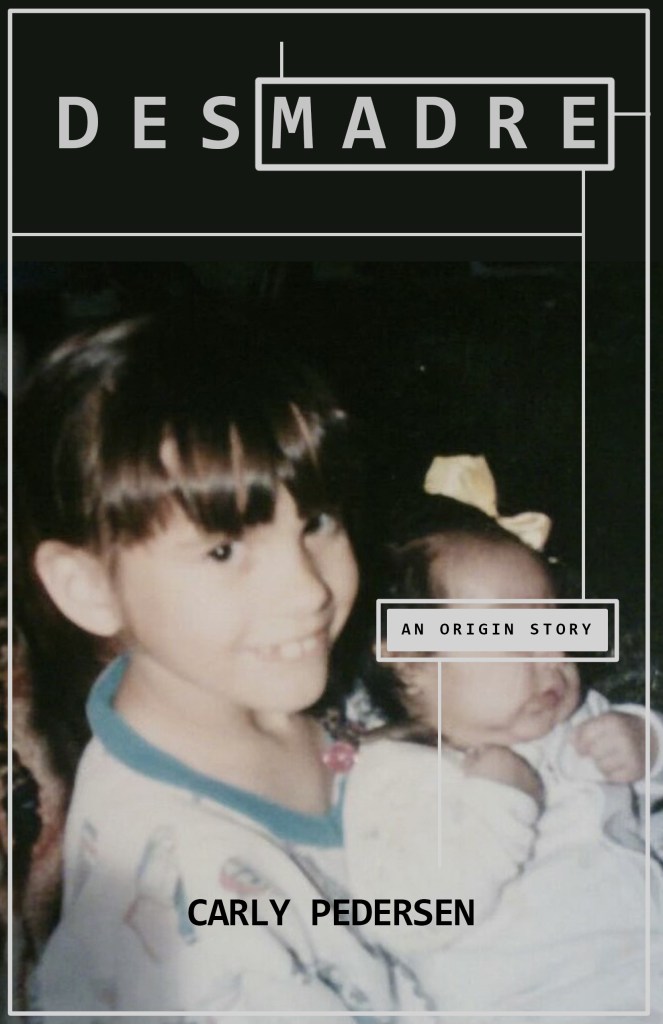
And part of what thrills me about Carly Pedersen’s new chapbook Desmadre: An Origin Story is that its zine-like form feels like such an exact match for the fragmented memories of trauma, for carrying a world within you that doesn’t match the world that now surrounds you. Desmadre is searing and electric and–as Carly says herself below–does leap from image to image in a way that allows her to quickly snap into focus a life, a family, a neighborhood.
You can read an excerpt from Desmadre: An Origin Story below my interview with Carly in which she describes so well why this book took this particular form. And also: You can buy the book here and read my blurb for it below.
Theo Nestor: Carly, tell us a bit about Desmadre and how this chapbook came to be?

Carly Pedersen: In my mid-30s, I began to understand how profoundly attachment injury was impacting my relationships. There was a fear of true closeness there, a desire to retreat from being seen, along with a gnawing sense of need that I refused to acknowledge. This is adaptive behavior from a tough childhood, and what works in a dysfunctional setting is no longer useful in a healthy one.
Putting this work out into the world is part of that recovery process. Letting others in on the secret, allowing myself to be known.
I embarked on a course of EMDR- Eye Movement Desensitization and Reprogramming, an extremely effective (and extremely trippy) therapeutic modality for treating trauma. I would often visualize myself as a giant during these sessions, tearing the roof off my childhood home and lifting Little Me out of the chaos, out of the desmadre.
Putting this work out into the world is part of that recovery process. Letting others in on the secret, allowing myself to be known. I’ve been so touched by the response to the chapbook. People see their own childhoods in it. There is so much commonality in trauma and in the ways we adapt to survive it.
Theo Nestor: What was a challenge you faced writing this book and how did you overcome it?
Carly Pedersen: Applying narrative structure to memories of traumatic events was my biggest challenge, because what we take from trauma is often implicit memory, not explicit memory. I took a note from EMDR when deciding how to structure this book. Find the feeling, find the cognitive distortion, and then find the earliest image connected to that. Writing this book often felt like leaping from one vivid image to another in my mind, each innocuous thing somehow laden with meaning. There’s a bowl of buttered noodles in this book that itself becomes a metaphor for shared pain. That’s what my brain held onto from those difficult years–a bowl of cheap noodles with six forks in it.
I didn’t want to wait for a big publisher’s permission to say what I needed to say, and I did not want to be constrained by form, attempting to stretch fragmented memories into traditional narrative.
Theo Nestor: How does the structure of this chapbook connect to its content?
Carly Pedersen: Another part of the recovery process was learning about who I am fundamentally. I am deeply pragmatic and can articulate difficult things with precision. I don’t like filler, in my writing or in my life. I didn’t want to wait for a big publisher’s permission to say what I needed to say, and I did not want to be constrained by form, attempting to stretch fragmented memories into traditional narrative. What emerged was a simple chapbook, modeled in many ways after my childhood mentor David Brown’s Assuming Blue, about serving as a medic in Vietnam.
The chapbook/zine format is also a nod to my younger self, printing and stapling punk zines together with my best friend, artist Hannah Litvin. We were two lost kids together, struggling to survive homelessness. There is something so right about mailing her this book, going back to that art form we shared and using it to tell this story.
Theo Nestor: How does it feel to have Desmadre out in the world and where can readers buy a copy of your book?
Carly Pedersen: I was shocked to see so many people buying the book on its first day out in the world. I just sat on the edge of my bed watching orders come in and feeling dumbstruck. What I’ve really taken away from the whole thing is how not alone I am in my experiences, and how much readers can truly engage with the nuances and non-traditional structure of this book. I’m happy that I trusted my audience to digest this work, to pick up what I was putting down, so to speak.
Desmadre: An Origin Story is available as an e-book or as a physical chapbook on carlypedersen.com. I’ve been enclosing a sticker with each physical chapbook: Raised in chaos. Thriving in spite.
Readers can also find me on Instagram at @carlotta_o.
Theo Nestor: Thank you, Carly! I loved reading Desmadre as an ebook and look forward to my hard copy of the chapbook arriving in the mail.
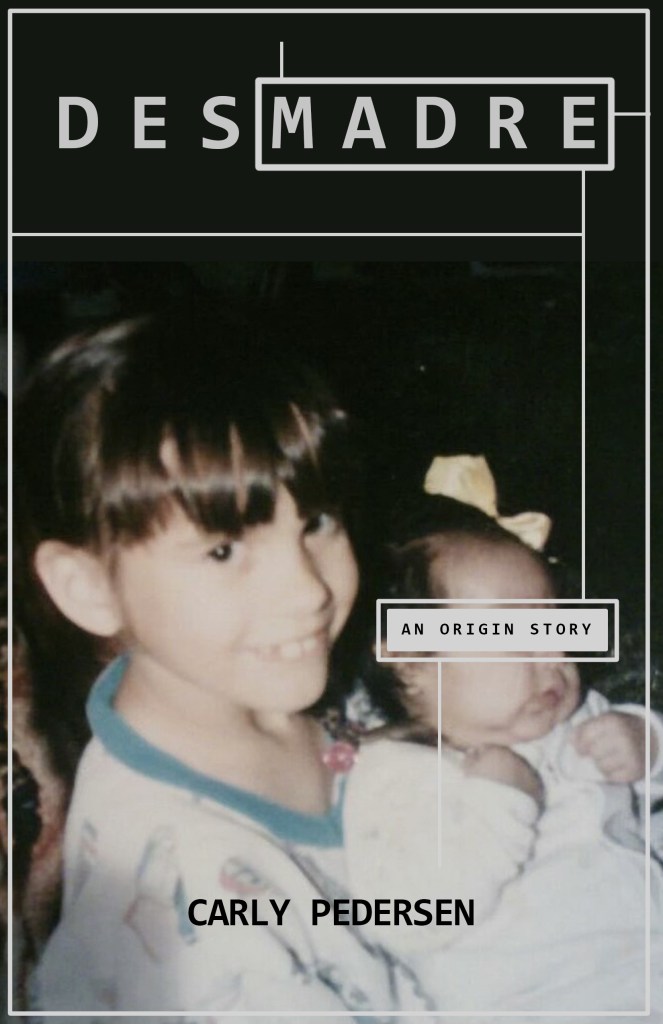
Excerpt from Demadre: An Origin Story
The first thing that happens when your mom overdoses and dies in her bedroom is that someone has to find her. And if you’re like me, when your mom overdoses and dies in her bedroom, you are across town, hanging out with a boy who is your friend but who also hopes you will take your clothes off in front of him one day.
It will be your little sister who finds her, blue. It will be your oldest sister who calls 911, who pulls your mother’s cold body to the floor and does CPR. You will come home on the bus, the last bus, because you’ve been avoiding home, and you will see a phalanx of ambulances. You will see your little brother weeping, screaming “Mom’s dead,” and you will scoff, “No she’s not,” and then some paramedics will keep you from going into your house and you will understand, in one sudden rush, that your mom is dead. You will reach out to hug your oldest sister, and find that she does not reach back.-From A Teenager’s Guide to Sudden Death, 2005
Author Bio
Carly Pedersen is a Mexican-American memoirist from Southwest Houston, Texas. Her work has appeared in Wordgathering and The Journal of Latina Critical Feminism. She lives in a small farming town in Washington.
Theo’s Blurb for Desmadre: An Origin Story
Maybe once a decade you come across a writer and think: I want to read everything they write. I don’t want to miss out on any of it. And Carly Pedersen is one of those writers. With a handful of words, she drops me into a world I’ve never seen that feels utterly familiar. I absolutely know this street she’s taking me down, I’m sure, but I don’t. It’s just that she brings to life so vividly our unnamed territories—the hollow echoing of our alienation, our rage over terrible losses rendered invisible, the love that remains in spite of it all. Carly Pedersen’s Desmadre: An Origin Story is searing and electric, and you don’t want to miss it. –Theo Pauline Nestor, author of Writing Is My Drink


 Writing Is My Drink
Leave a Reply